
Paint Sheen Guide: The Right Finish for Cabinets, Walls & Trim
Flat, eggshell, satin and gloss explained for a well-finished home
A paint colour is only part of the finished look. The sheen determines how much light the surface reflects, which can change the way cabinetry, walls and trim sit together in a room. A quiet wall finish and a more reflective cabinet finish create a different effect from using the same sheen everywhere.
This paint sheen guide helps homeowners in Vaughan, Toronto and the GTA compare common finishes for a kitchen renovation or custom millwork project. Use it to build a shortlist, then confirm the actual coating and a finished sample with your painter or cabinet maker.
What is paint sheen?
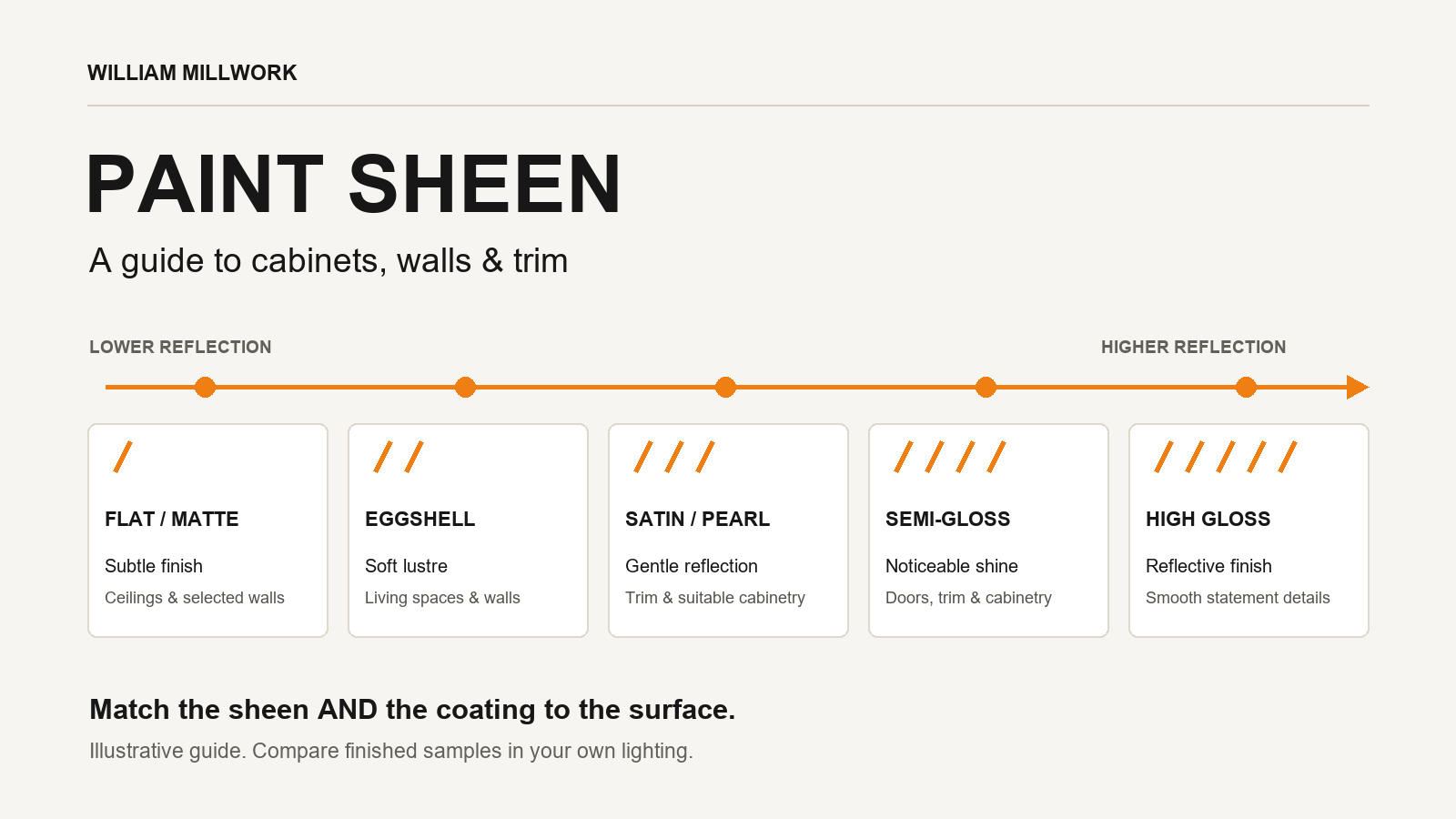
Sheen describes the amount of shine in a dried finish. Common labels run from flat and matte through eggshell, satin or pearl, semi-gloss and high gloss. Names and exact gloss levels vary between manufacturers and product lines, so compare samples of the specific product you intend to use.
Lower-sheen finishes generally make texture less noticeable. More reflective finishes draw attention to a surface and its details. A sheen label alone does not tell you whether a paint is suitable for cabinet doors, regular washing or a humid bathroom. Those decisions also depend on the coating’s formulation and the manufacturer’s directions.
Paint sheen guide: a quick comparison
| Sheen | Appearance | Where to start |
|---|---|---|
| Flat / matte | Minimal reflection | Ceilings and selected walls; check washability and room suitability. |
| Eggshell | A soft, low sheen | Living spaces and walls where a gentle finish is preferred. |
| Satin / pearl | A noticeable but restrained lustre | Trim, doors and cabinetry when the chosen coating is designed for them. |
| Semi-gloss | A brighter reflective finish | Baseboards, mouldings, doors and suitable cabinet finishes. |
| High gloss | The strongest reflection in this group | Carefully prepared statement doors, cabinetry and architectural details. |
Choosing a finish for walls and ceilings
Flat or matte: Start here when you want a quieter ceiling or want wall texture to attract less attention. An uneven wall near a window deserves a sample test: light passing across it can reveal marks that are less obvious under general room lighting.
Eggshell: A useful comparison for living rooms, bedrooms and other walls when you want a little reflection. For hallways or family spaces that need frequent wiping, check the selected product’s cleaning instructions rather than choosing by the sheen name alone.
Satin or pearl: Consider these when you want wall panelling, doors or trim to have more definition. Test the finish across a broad surface as well as a small trim piece; a sheen you like on a narrow moulding may feel more prominent across an entire wall.
Satin vs. semi-gloss for kitchen cabinets
Satin can give cabinetry a softer appearance, while semi-gloss creates a clearer reflection. Compare both on a cabinet door sample beside your countertop, backsplash and hardware. Think about whether you want the cabinet fronts to blend into the room or emphasize the door profile.
Choose a coating intended for cabinetry or woodwork. Sherwin-Williams’ cabinet painting guide identifies satin, semi-gloss and gloss as suitable sheen options within a cabinet finishing approach. That does not make a wall paint in the same sheen an interchangeable cabinet coating.
For custom cabinetry, ask which finishing system will actually be applied and what care it requires. Approve the colour and sheen together on the proposed surface. If you are considering white cabinets, pair this guide with our Benjamin Moore white and off-white colour guide.
When does high gloss make sense?
High gloss creates a strong visual statement. It can suit an accent cabinet, a feature door or a carefully finished architectural detail. Because reflections make surface irregularities more apparent, discuss preparation and the desired smoothness before choosing it.
If you prefer a restrained palette, compare a gloss sample with satin or semi-gloss in the room. Look at it from more than one angle and under evening lighting; an attractive highlight in a showroom can feel different beside a large window at home.
Bathroom walls need a product-specific choice
Room-by-room sheen charts are useful starting points, but bathrooms need a closer product check. A room that regularly fills with shower steam needs a coating intended for those conditions, whichever sheen you prefer.
A higher sheen is not the only route. Benjamin Moore’s Canadian Aura Bath & Spa technical sheet describes a matte coating formulated for high-humidity spaces. Its directions also specify a waiting period before washing and explain that cool temperatures and high humidity extend service times. Follow the instructions for your chosen product, and consider ventilation as part of the room plan.
Four checks before approving your millwork finish
- Bring the materials together. Compare the finish with your flooring, stone, hardware and adjacent walls. Matching a colour name alone does not show how the whole room will feel.
- Use the lighting you will live with. Check daylight, ceiling lights and task lighting. Our kitchen lighting guide can help you think through that setting.
- Approve the actual finish. Request a sample using the proposed coating, substrate and sheen. A wall-painted sample board is a useful colour reference, but a cabinet-door sample gives a better basis for approving cabinetry.
- Confirm care and timing. Ask when the finish can be handled, cleaned and put into full service. Follow the product or finisher’s directions rather than assuming a surface is ready as soon as it feels dry.
Frequently asked questions
Is satin always the best sheen for cabinets?
Satin is a useful starting point for a softer look. Semi-gloss or gloss may suit a different design. The best choice is the sheen you approve within a coating designed for your cabinetry, tested with your materials and lighting.
Can I use the same colour in different sheens?
Yes, but compare finished samples first. Reflection can change how the colour appears. Check the combination where a wall, cabinet or trim piece meets the next surface, especially when your palette uses several whites.
Does a higher sheen guarantee a more durable finish?
No. Formulation, surface preparation, application and curing all matter. Compare the technical information and care requirements of the specific products under consideration.
Plan a coordinated finish with William Millwork
A finish choice works best when it is considered alongside the rest of the design. Explore our custom cabinetry services, custom millwork services and completed projects. To discuss cabinetry or millwork for your Vaughan or GTA home, contact William Millwork with your colour shortlist and material samples.
References
This article was inspired by the Chris Loves Julia Paint Sheen Guide. General finish information was checked against Benjamin Moore Canada’s paint finish guide, Sherwin-Williams’ sheen guide, its cabinet painting guidance and the Canadian Aura Bath & Spa technical sheet linked above. References checked on October 3, 2026.